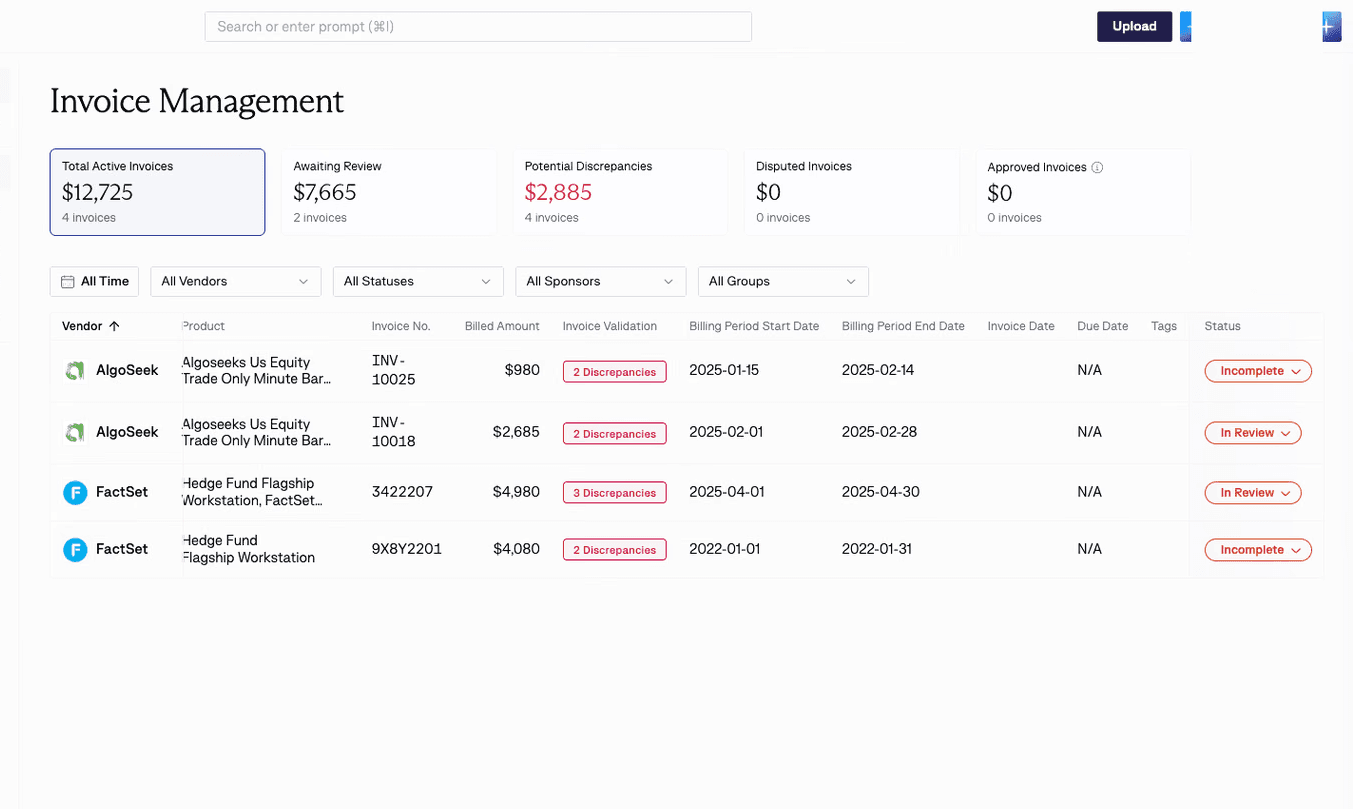
Start with the governing position
To reconcile a vendor invoice, establish which obligations and economics apply to the invoiced service and period, then compare the invoice with that position. A matching supplier name and total are not enough. The invoice may reflect a prior price, a removed service or a different billing period.
Collect the master agreement, service orders, amendments and relevant operating records. Retain document relationships rather than treating the newest file as a replacement for everything that came before it. Record missing documents explicitly so a reviewer can distinguish an evidenced discrepancy from an unresolved question.
Build a repeatable evidence path
- 01Identify the supplier, contracting entity and service order.
- 02Resolve the dates, scope and current fee schedule.
- 03Match invoice lines to products, quantities and periods.
- 04Assign exceptions with source evidence and follow-up.
Check the records at line level
Use a consistent review worksheet. Keep the contractual source beside the operational record and invoice line, including the source location and the reason for any interpretation. Where product names differ, record the mapping and who confirmed it rather than silently treating two labels as equivalent.
Check: Applicable entity, scope and effective dates
Potential mismatch: A later signature is mistaken for a later effective date.
Check: Product, rate, currency and charging basis
Potential mismatch: A removed service remains on the invoice.
Check: Users, subscriptions, quantities and billed period
Potential mismatch: An operating quantity has changed but billing has not.
Work the exception, not just the number
Illustrative example: an amendment removes one service partway through a billing period. First establish its effective date and the service it covers. Check whether the invoice includes that service for the full period, and whether the agreement defines proration or a separate adjustment process. Do not infer a credit simply because the service was removed.
Give the exception an owner, an evidence reference and a next step. The outcome may be a vendor clarification, an internal mapping correction or a commercial discussion. Preserve that outcome with the original finding so the next cycle does not restart the same investigation.
Make the next cycle easier to review
A useful reconciliation process preserves what was checked, what remains unresolved and which changes must be reflected in future billing. Keep approval and payment decisions in the organization’s authorized workflow. Source-backed context supports review; it is not permission to approve an invoice automatically.
PostSig CPM connects commercial commitments to invoices, spend, products and operating records. LineageAI provides the shared foundation for relationships, dates, scope and source evidence. Evaluate that context against a real, bounded workflow before deciding how it should fit your process.