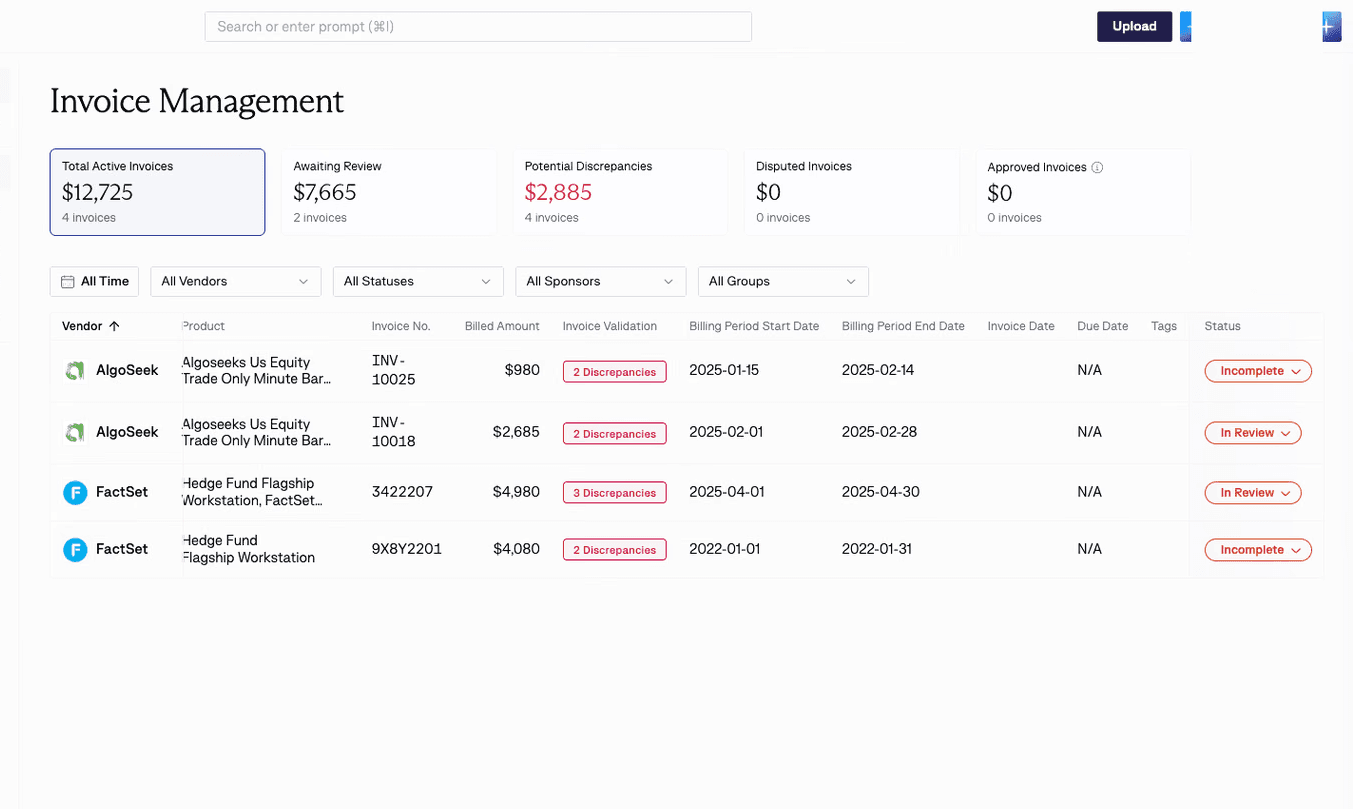
Evaluate the answer to a dated finance question
Assess contract evidence tools against a dated business question that connects an invoice or commitment, the applicable agreement family, source evidence and an accountable review. Start with a question such as: which price applies to this service for this billing period? Define what the reviewer must establish before comparing interfaces.
Finance teams often need several systems to answer that question. Accounting records show transactions; procurement records capture purchasing activity; agreements describe commercial terms. The evaluation should reveal how those records work together, not declare a single category the winner.
Understand the complementary roles
Document search helps people locate relevant language and source files. Extraction organizes selected information for review. CLM supports agreement processes and managed contract records. ERP and procurement systems provide transaction, purchase and supplier context. Connected contract evidence brings the governing relationships and dated terms into an operating question.
Ask where each category fits your existing process and what a reviewer still has to connect manually. A tool can be useful for locating a clause without being the place where finance records its payment decision. Distinguish those jobs before setting acceptance criteria.
Compare evidence, not feature scores
Use the same question and sample records with each tool. Record whether evidence was directly available, supplied by another system or still required. This is a comparison of review responsibilities, not a ranking based on an invented feature score.
| Question | Useful record | Evidence to request |
|---|---|---|
| Which charge is being reviewed? | Invoice line and purchase record | Service identity, quantity, billing basis and period. |
| Which price applies? | Agreement, schedule and amendment | Original and changed prices, effective date and affected scope. |
| Can someone reproduce the review? | Review packet and decision record | Source locations, assumptions, reviewer and open requests. |
Work a mid-period price amendment
Illustrative example: a supplier invoices a full month at a revised price, while an amendment becomes effective halfway through that period. The accounting total confirms the amount recorded, but not whether the full-period charge follows the agreement.
An isolated price clause is also insufficient. Inspect the affected service, effective date, billing convention and any referenced schedule. Ask whether the proposed treatment requires a split period, a different charging basis or additional clarification. Preserve the question for the authorized finance reviewer rather than silently applying an assumption.
Make the review repeatable
Ask who owns new amendments, supplier mappings and unresolved evidence requests. Repeat the sample review after adding a limited change. Can a second person understand why the answer changed and what remained the same? Keep the prior review with its date instead of replacing it with an unexplained current value.
A practical outcome is a reusable review packet: question, transaction, governing sources, applicable changes, assumptions and named next step. PostSig CPM connects commercial commitments to invoices, spend and operating records, with LineageAI supplying shared source-backed context. Evaluate that connection against your finance workflow and the responsibilities your team will continue to own.