THE PROBLEM
Defend every mark
with the evidence behind it.
Connect valuation support to rights, economics, and source documents.
PostSig IRI ties ownership, preferences, financing history, and source evidence to the portfolio record behind each valuation review.
Book Demo
See IRI in Action
Defend every mark
READY
Audit request
Ownership
FMV support
Rights
Changes
Question → evidence
Current answer
Source docs
Review path
Evidence pack
Question → Answer → Source → Review path → Evidence pack.
Confirm ownership with source evidence
Connect holdings to investment documents, cap table support, and financing history.
Support valuation review
Link FMV support to cost basis, ownership context, valuation terms, and portfolio records.
See rights in context
Understand preferences, approvals, side letters, and amendments across history.
Track what changed
Compare the current record to prior rounds, prior evidence, and last year’s audit context.
VC audits become painful when the portfolio record is scattered.
Ownership evidence
Rights context
Valuation support
Changes since last review
THE PROBLEM
VC audits become painful when the portfolio record is scattered.
Audit readiness is not having documents somewhere. It is being able to prove the current portfolio record with source-backed evidence across ownership, valuation, rights, side letters, amendments, and financing history.
Audit season should be a review process. For many venture firms, it becomes an annual search operation. Ownership data lives in one system. Investment documents live in folders. Side letters live in email. Valuation support lives in spreadsheets. Major investor rights live in PDFs. Amendments and follow-on rounds change the current answer.
Every year, teams rebuild the same record across finance, fund ops, legal, and investment teams. That is not readiness. That is archaeology.
Audit readiness is not having documents somewhere. It is being able to prove the current portfolio record with source-backed evidence across ownership, valuation, rights, side letters, amendments, and financing history.
Audit season should be a review process. For many venture firms, it becomes an annual search operation. Ownership data lives in one system. Investment documents live in folders. Side letters live in email. Valuation support lives in spreadsheets. Major investor rights live in PDFs. Amendments and follow-on rounds change the current answer.
Every year, teams rebuild the same record across finance, fund ops, legal, and investment teams. That is not readiness. That is archaeology.
Audit readiness is not having documents somewhere. It is being able to prove the current portfolio record with source-backed evidence across ownership, valuation, rights, side letters, amendments, and financing history.
Audit season should be a review process. For many venture firms, it becomes an annual search operation. Ownership data lives in one system. Investment documents live in folders. Side letters live in email. Valuation support lives in spreadsheets. Major investor rights live in PDFs. Amendments and follow-on rounds change the current answer.
Every year, teams rebuild the same record across finance, fund ops, legal, and investment teams. That is not readiness. That is archaeology.
Manual reconstruction is not audit readiness. It is an annual tax on institutional memory.
THE PROBLEM
VC audits become painful when the portfolio record is scattered.
Audit support breaks when teams treat the portfolio record as static. Ownership changes, valuation support evolves, rights get amended, side letters create exceptions, and later financings rewrite context.
01
Original Investment
02
Side Letter
03
Amendment
04
New Financing
05
Current Rights + Audit Evidence
Static records tell you what was signed. IRI needs the current truth: what governs now, and why.
THE PROBLEM
LineageAI™ connects the document history to the current answer.
It does not just summarize one document. It understands how agreements, side letters, amendments, and later events relate over time, so teams can see what governs now.
Confirm ownership with source evidence
Connect holdings to investment documents, cap table support, and financing history.
Support valuation review
Link FMV support to cost basis, ownership context, valuation terms, and portfolio records.
See rights in context
Compare the current record to prior rounds, prior evidence, and last year’s audit context.
APPLIED INSIDE IRI
Inside IRI, LineageAI™ becomes an audit workflow: current answer, source evidence, review path, and evidence pack.
THE PROBLEM
IRI unlocks the intelligence locked inside your documents.
Document Intelligence identifies what each agreement says. Cross-document intelligence shows how agreements relate over time. LineageAI™ keeps the answer current as new documents arrive.
YOUR CURRENT STACK
Confirm ownership with source evidence
Connect holdings to investment documents, cap table support, and financing history.
WHAT IRI UNLOCKS
Support valuation review
Link FMV support to cost basis, ownership context, valuation terms, and portfolio records.
YOUR CURRENT STACK
See rights in context
Understand preferences, approvals, side letters, and amendments across history.
WHAT IRI UNLOCKS
Track what changed
Compare the current record to prior rounds, prior evidence, and last year’s audit context.
YOUR CURRENT STACK
Amendments and new rounds
Change the answer across documents, time, and jurisdictions.
WHAT IRI UNLOCKS
Cross-document lineage
Connects related records to understand how terms relate, what changed, and what supersedes what.
YOUR CURRENT STACK
Spreadsheets and portfolio systems
Track numbers, notes, status, ownership, and company context.
WHAT IRI UNLOCKS
Current governing view
Connects operational data to document context so teams see what is current and what governs now.
Confirm ownership with source evidence
Connect holdings to investment documents, cap table support, and financing history.
Support valuation review
Link FMV support to cost basis, ownership context, valuation terms, and portfolio records.
See rights in context
Understand preferences, approvals, side letters, and amendments across history.
Track what changed
Compare the current record to prior rounds, prior evidence, and last year’s audit context.
THE PROBLEM
The questions your auditors ask are the questions IRI was built to answer.
Each row starts with a real question and shows how IRI connects the current answer to source evidence. The goal is not faster search. It is a defensible current record.
AUDIT QUESTION
IRI ANSWER
SOURCE EVIDENCE
What did we own at year-end?
Connects the portfolio company record to ownership evidence, investment history, capitalization context, and supporting documents.
Investment agreements, cap table extracts, closing documents, follow-on financings, cost and ownership records.
What changed since the last audit?
Shows how rounds, amendments, side letters, and rights evolved over time.
Prior-year evidence, new financing rounds, amendments, restatements, side letters, updated rights and terms.
What supports our fair value position?
Connects FMV support to ownership, cost, valuation-related terms, financing history, and source documents.
FMV support, cost basis, valuation terms, recent financing events, board and company materials.
Which rights are still in force?
Surfaces current investor rights, preferences, approvals, and major investor terms across document history.
Investor rights agreements, side letters, amendments, financing documents, liquidation preferences, approval rights.
What evidence supports our answer?
Keeps each answer tied to source context, extracted terms, lineage, and review history.
Source documents, extracted terms, document lineage, audit log, review history, evidence packs.
Who needs to act before the request gets stale?
Helps teams see what is missing, what needs review, and where follow-up is required.
Open audit questions, missing evidence, portfolio company follow-ups, legal review needs, finance review needs.
THE PROBLEM
From audit scramble to continuous readiness.
Before IRI
Ownership and rights evidence rebuilt manually
Side letters and amendments checked one by one
Audit answers depend on institutional memory
Evidence packs take too long to assemble
With PostSig IRI
Current portfolio record is already connected
Answers tie back to documents, lineage, and evidence
Review paths are visible before evidence leaves the firm
Audit requests move faster with less fire-drill work
THE PROBLEM
Built for the teams pulled into every audit cycle.
Confirm ownership with source evidence
Connect holdings to investment documents, cap table support, and financing history.
Firm leadership
Needs confidence that the firm has control over portfolio records, audit support, and LP-facing evidence. Outcome: fewer surprises.
Track what changed
Compare the current record to prior rounds, prior evidence, and last year’s audit context.
Support valuation review
Link FMV support to cost basis, ownership context, valuation terms, and portfolio records.
See rights in context
Understand preferences, approvals, side letters, and amendments across history.
THE PROBLEM
Common questions about IRI.
Why do VC funds need audit-ready portfolio records?
Annual fund audits often require evidence supporting ownership, valuation, rights, financing history, and portfolio company information.
What documents are commonly needed during a VC fund audit?
Investment agreements, closing documents, cap table extracts, SAFEs, notes, warrants, side letters, investor rights agreements, amendments, board materials, valuation support, FMV documentation, financials, and portfolio company updates.
Why is VC audit readiness harder now?
Private-market portfolios are more complex. Companies raise multiple rounds, rights change, valuations are scrutinized, side letters accumulate, and LPs expect more transparency.
How does PostSig IRI help with VC audit readiness?
IRI connects ownership records, investor rights, valuation support, side letters, amendments, and source documents into a governed portfolio company record.
Does PostSig IRI replace cap table software?
No. IRI complements cap table data by connecting ownership and capitalization context to investor rights, legal documents, valuation support, side letters, amendments, and evidence lineage.
Does PostSig IRI replace legal review?
No. IRI helps legal, finance, fund operations, and investment teams work from a structured, source-backed record so legal review can happen faster and with better context.
What is LineageAI’s role in audit readiness?
LineageAI™ helps connect documents, terms, amendments, side letters, and financing rounds over time so teams can see how the current answer was formed.
THE PROBLEM
The operating intelligence layer for investor rights.
The same IRI foundation supports audit readiness, valuation review, LP reporting, approvals, rights tracking, diligence, and exit preparation.
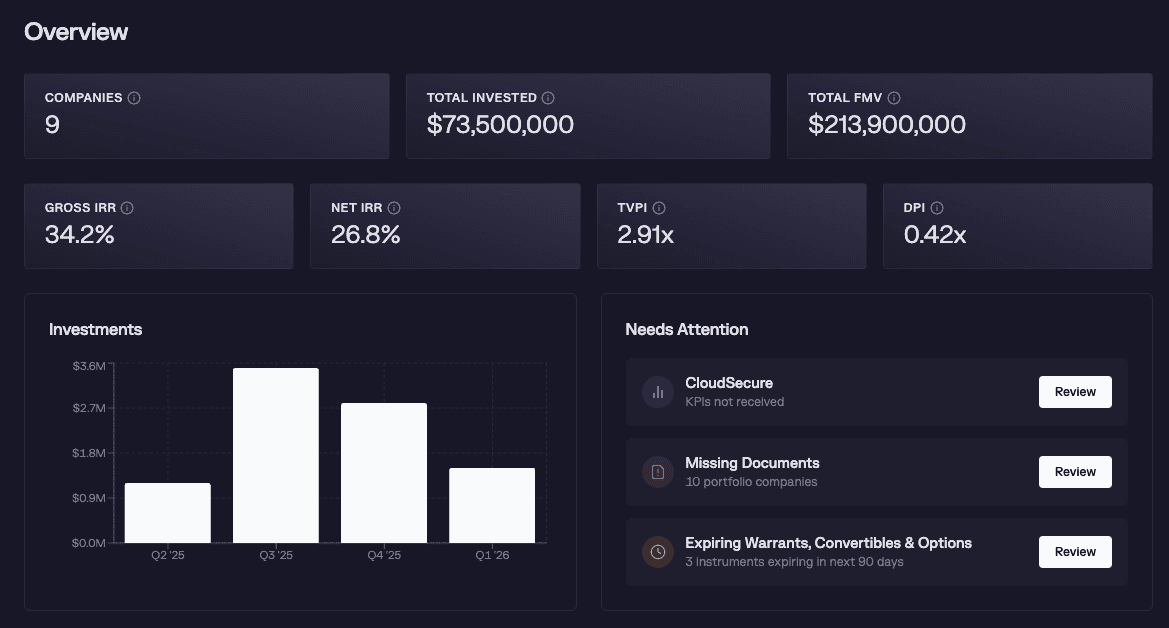
IRI PLATFORM VIEW
A current operating view across rights, economics, workflow, and evidence.
Confirm ownership with source evidence
Connect holdings to investment documents, cap table support, and financing history.
Track what changed
Compare the current record to prior rounds, prior evidence, and last year’s audit context.
Cap Tables & Economics
Connect ownership, cost basis, FMV, liquidation preferences, seniority, and round history.
See rights in context
Understand preferences, approvals, side letters, and amendments across history.
Support valuation review
Link FMV support to cost basis, ownership context, valuation terms, and portfolio records.
Rights Intelligence
Surface information rights, consent rights, approval thresholds, protective provisions, and governance constraints.
THE PROBLEM
Make audit readiness continuous.
Your annual audit should not depend on who remembers where the side letter lives. PostSig IRI helps venture firms govern the portfolio record continuously, so ownership, rights, valuation support, and source evidence are ready before the request lands.
Book a Demo
See IRI in Action
Don’t reconstruct the portfolio every year. Govern it continuously.
OS for
Venture.
Operating intelligence for venture scale.