
Rights Change Tracking
See what changed
and what governs now.
Follow rights across rounds, side letters, amendments, and waivers.
PostSig IRI connects the document history to the current answer so teams can see what was added, modified, superseded, and still active.
Current governing view
RIGHTS LINEAGE
Audit request
Ownership
FMV support
Rights
Changes
Original → Change → Now
Added
Modified
Waived
Still active
What governs now
Track rights across rounds
Connect original documents to later financings, amendments, and restatements.
See what changed
Identify rights that were added, modified, waived, replaced, or superseded.
Preserve current-state context
Understand which rights still apply today.
Connect changes to evidence
Trace every answer back to the source documents behind it.
Current governing view
Ownership evidence
Rights context
Valuation support
Changes since last review
THE PROBLEM
Investor rights change. Static records do not.
Rights change tracking shows what governs now. It connects how investor rights, approvals, economics, and constraints evolved across rounds, side letters, amendments, waivers, and portfolio events.
The rights negotiated at entry rarely stay simple. New rounds happen. Side letters get signed. Amendments update terms. Thresholds shift. Notes convert. Secondaries affect ownership. Restructurings change economics.
Over time, teams may remember what was negotiated, but not what is currently in force. That gap creates governance drift.
The current answer should not depend on institutional memory.
THE RECORD KEEPS MOVING
The original deal is not always what governs now.
Investor rights evolve through amendments, waivers, side letters, financings, conversions, and restructurings. The current answer lives across the document history.
01
Original Right
02
Side Letter
03
Amendment
04
New Financing
05
Current Governing View
Static records tell you what was signed. IRI needs the current truth: what governs now, and why.
LINEAGEAI™
LineageAI™ connects the document history to the current answer.
It does not just summarize one document. It understands how agreements, side letters, amendments, and later events relate over time, so teams can see what governs now.
Cross-document intelligence
Connects agreements, side letters, amendments, restatements, and related records.
Temporal change tracking
Understands how rights, economics, approvals, and evidence changed over time.
Source-backed answers
Keeps every current answer tied to the documents and lineage behind it.
APPLIED INSIDE IRI
Inside IRI, LineageAI™ becomes an audit workflow: current answer, source evidence, review path, and evidence pack.
CURRENT STACK → IRI
IRI unlocks the intelligence locked inside your documents.
Document Intelligence identifies what each agreement says. Cross-document intelligence shows how agreements relate over time. LineageAI™ keeps the answer current as new documents arrive.
YOUR CURRENT STACK
CLM
Captures negotiated intent and manages the path to signature.
WHAT IRI UNLOCKS
Post-signature intelligence
Turns signed agreements into living investor-rights intelligence teams can act on as the portfolio changes.
YOUR CURRENT STACK
File storage / repositories
Holds agreements, side letters, amendments, and supporting files.
WHAT IRI UNLOCKS
Document Intelligence
Extracts the rights, obligations, economics, and evidence locked inside each document.
YOUR CURRENT STACK
Amendments and new rounds
Change the answer across documents, time, and jurisdictions.
WHAT IRI UNLOCKS
Cross-document lineage
Connects related records to understand how terms relate, what changed, and what supersedes what.
YOUR CURRENT STACK
Spreadsheets and portfolio systems
Track numbers, notes, status, ownership, and company context.
WHAT IRI UNLOCKS
Current governing view
Connects operational data to document context so teams see what is current and what governs now.
Economics
Ownership, preferences, cost basis, and value context stay connected to evidence.
Control
Consent rights, approvals, thresholds, and restrictions stay visible before decisions move.
Defensibility
Every answer can be traced back to source documents and review history.
Timing
Teams answer faster when audits, LP requests, diligence, or exits compress timelines.
RIGHTS CHANGE QUESTIONS IRI ANSWERS
The rights-change questions your team asks are the questions IRI was built to answer.
Each row starts with a real question and shows how IRI connects the current answer to source evidence. The goal is not faster search. It is a defensible current record.
Rights Question
IRI Answer
Source Evidence
What changed since the original investment?
Connects new rounds, amendments, side letters, waivers, and restatements to the company record.
Original agreements, later financings, amendments, side letters, restatements.
Which rights are still active?
Shows current rights by portfolio company, investor context, and governing document.
Investor rights agreements, side letters, ownership records, updated terms.
Which rights were modified or waived?
Tracks changes across the document history.
Amendments, waivers, restatements, side letters, financing documents.
Which document changed the right?
Links each rights change back to the source document.
Document lineage, extracted terms, review history, source files.
What approvals apply now?
Connects current approval rights to the governing document set.
Consent provisions, protective provisions, amendments, updated rights.
What governs the next financing, board action, or exit?
Surfaces the current governing view before a new event moves forward.
Current rights summary, document lineage, amendments, side letters, approval context.
BEFORE / AFTER IRI
From document history to the current governing view.
Before IRI
The original deal is treated as the current answer
Amendments, waivers, and side letters are checked manually
Superseded terms are hard to spot
Teams debate what governs now
With PostSig IRI
Rights changes are connected across time
Superseded, modified, and active terms are easier to see
Current rights are tied to source evidence
Teams work from the same governing view
ROLE-BASED VALUE
Built for portfolios that keep changing.
Investment teams
Need better decisions with less reconstruction across rounds, side letters, and amendments.
Legal and fund counsel
Need faster review and fewer repeated document reads.
Fund CFOs and finance teams
Need clearer support for finance cycles, audit, valuation, and reporting.
Fund operations
Need less drift between trackers, documents, and portfolio events.
Firm leadership
Needs stronger control across the portfolio record.
FAQ
Rights Change Tracking FAQ
What is rights change tracking?
Rights change tracking is the process of understanding how investor rights change across rounds, amendments, side letters, waivers, restatements, ownership changes, and portfolio events.
Why do investor rights change?
Rights may change after new financings, side letters, amendments, ownership threshold changes, conversions, restructurings, secondaries, or exits.
How does IRI show what governs now?
IRI connects related documents across time and surfaces the current rights, approvals, economics, and constraints for each portfolio company.
What does LineageAI™ do?
LineageAI™ connects terms, rights, amendments, side letters, and financing rounds across documents and time.
Does IRI replace legal review?
No. IRI helps legal review happen faster by organizing source documents, changes, and current-state context.
Which teams benefit from rights change tracking?
Investment, legal, finance, fund operations, and leadership teams use rights change tracking to reduce drift between documents, trackers, and decisions.
IRI PLATFORM
The operating intelligence layer for investor rights.
The same IRI foundation supports audit readiness, valuation review, LP reporting, approvals, rights tracking, diligence, and exit preparation.
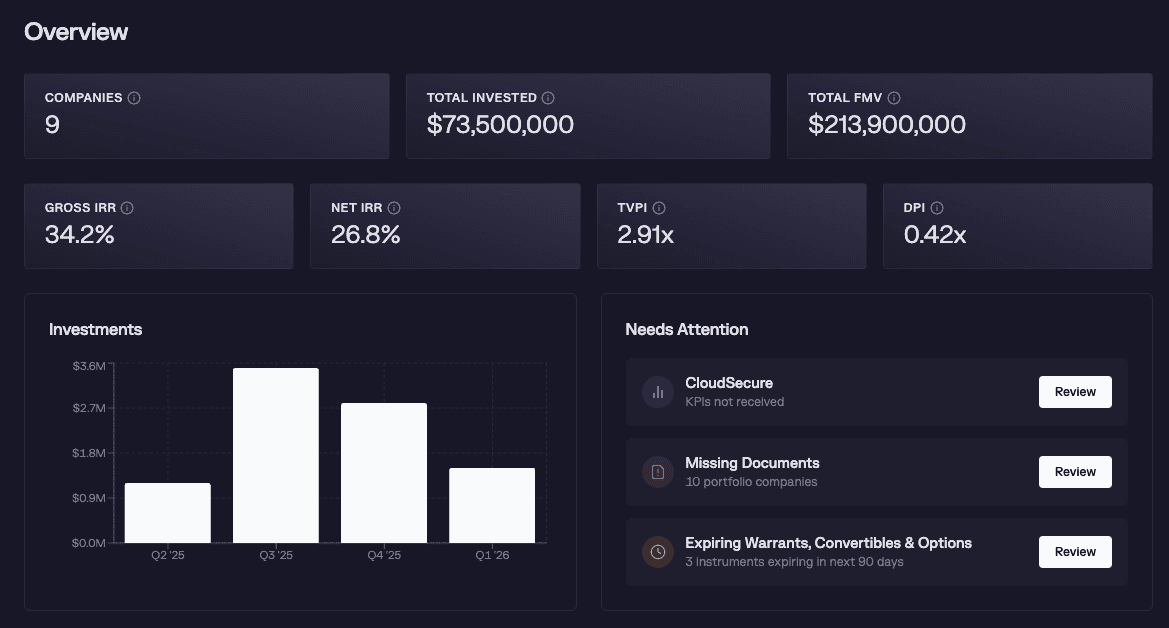
IRI PLATFORM VIEW
A current operating view across rights, economics, workflow, and evidence.
Deal Workflow
Move audits, approvals, diligence, exits, and portfolio follow-up from question to reviewable action.
Portfolio Intelligence
See firm-wide exposure, fund-level rights, and portfolio company context without rebuilding history.
Cap Tables & Economics
Connect ownership, cost basis, FMV, liquidation preferences, seniority, and round history.
Cross-Document Intelligence
LineageAI™ connects related documents to show what is in force now.
LP Reporting
Connect information rights, fund/entity context, and source evidence behind reporting requests.
Rights Intelligence
Surface information rights, consent rights, approval thresholds, protective provisions, and governance constraints.
READY WHEN IT MATTERS
See what changed and what governs now.
See how IRI connects rights history, amendments, waivers, and source evidence into one current view.
The original deal is not always what governs now.
OS for
Venture.
Operating intelligence for venture scale.